
How to Evaluate the Performance of an Erbium Glass Laser?
1. Six Key Parameters for Evaluating Erbium Glass Laser Performance
(1) Output Wavelength Accuracy and Stability
Output wavelength is one of the fundamental parameters used to evaluate an erbium glass laser.
For example, a 1535 nm erbium glass laser should produce an output wavelength within its specified operating range. In addition to the center wavelength, it is important to understand how the wavelength changes with temperature and operating time.
If the output wavelength deviates significantly from its specified range, it may affect detector response and compatibility with other optical components.
When evaluating wavelength performance, consider the following:
- Whether the center wavelength meets the specified requirements.
- Whether wavelength deviation remains within the allowable range.
- Whether the wavelength remains stable under different temperatures.
- Whether significant wavelength drift occurs during long-term operation.
(2) Pulse Energy Performance
For pulsed erbium glass lasers, pulse energy is one of the most important performance indicators.
Pulse energy refers to the energy delivered in a single laser pulse and is typically measured in microjoules (μJ) or millijoules (mJ).
For example, if a laser has a specified pulse energy of 100 μJ but its actual measured output is significantly lower, further investigation may be needed. Possible factors include pump efficiency, laser glass characteristics, resonator design, and driver circuit performance.
However, higher pulse energy does not always mean better performance. For laser ranging applications, the required energy also depends on detection distance, target reflectivity, receiver sensitivity, and laser safety requirements.
Key evaluation points:
1.Whether the measured pulse energy meets the rated specification.
2.Whether pulse energy remains consistent from pulse to pulse.
3.Whether energy decreases during continuous operation.
4.Whether pulse energy remains stable under different temperature conditions.
(3) Pulse Width and Peak Power
Pulse width refers to the duration of an individual laser pulse and is usually measured in nanoseconds (ns).
For lasers with the same pulse energy, a shorter pulse generally produces higher peak power.
For example, consider two lasers with the same pulse energy of 100 μJ:
1.Laser A: 10 ns pulse width.
1.Laser B: 20 ns pulse width.
Assuming the same pulse-width definition, Laser A generally has approximately twice the peak power of Laser B.
Actual peak power also depends on the pulse waveform, so pulse width alone is not sufficient to determine performance.
In laser ranging systems, pulse width affects timing resolution. It should therefore be evaluated according to measurement accuracy, detection distance, and receiver characteristics.
(4) Repetition Rate Stability
Repetition rate indicates how many laser pulses are emitted per second and is measured in hertz (Hz).
For example, a repetition rate of 10 Hz means that the laser emits ten pulses per second.
Repetition rate affects the number of measurements that can be performed within a given period. It also influences average output power and thermal management requirements.
A well-performing erbium glass laser should maintain a stable repetition rate under its specified operating conditions. Frequent missed pulses, irregular pulse intervals, or unexpected interruptions may indicate performance issues.
Important evaluation points include:
1.Whether the actual repetition rate meets the specification.
2.Whether pulse intervals remain consistent.
- Whether missed pulses occur during extended operation.
- Whether the laser operates reliably under different conditions.
(5) Beam Quality and Divergence
Beam quality determines how laser energy is distributed spatially, while beam divergence describes how much the laser beam expands as it travels.
For long-range laser ranging applications, a smaller divergence angle generally helps maintain a smaller beam spot over long distances and improves energy concentration on the target.
However, beam quality should not be evaluated based on divergence alone. Spot shape, energy distribution, and pointing stability should also be considered.
For example, significant beam asymmetry, uneven energy distribution, or pointing drift may negatively affect the overall performance of a ranging system.
(6) Long-Term Stability and Service Life
For industrial equipment and optoelectronic systems, long-term operating stability is just as important as initial output performance.
Some lasers may perform well during initial testing but experience pulse energy degradation, wavelength drift, or unstable output after extended operation.
Therefore, long-term reliability should also be considered when evaluating an erbium glass laser.
Important factors include:
1.Pulse energy changes during extended operation.
2.Operating stability of the pump diode.
3.Effects of temperature variations on output performance.
4.Performance under vibration and mechanical shock.
5.Lifetime testing and reliability verification data.
2. How to Test Erbium Glass Laser Performance
In addition to reviewing the product datasheet, actual measurements can provide a more accurate understanding of laser performance.
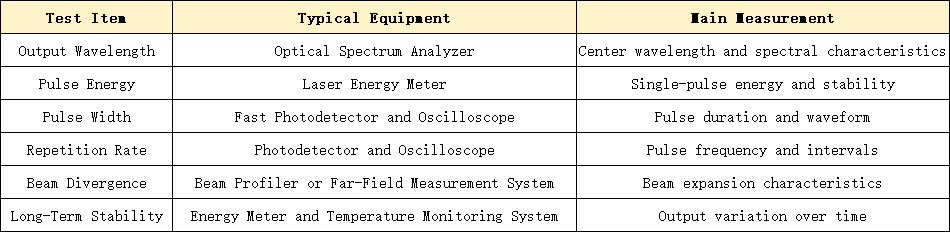
These measurements help determine whether the actual laser performance matches the manufacturer's specifications.
For reliable comparisons, testing conditions should be consistent. Operating temperature, drive voltage, trigger method, and warm-up time should all be controlled. Otherwise, results from different tests may not be directly comparable.
3. Do Higher Specifications Always Mean Better Performance?
The answer is no.
Different applications have different requirements for erbium glass lasers.
1.Laser Rangefinding: Pulse energy, pulse width, and output stability are particularly important.
2.LiDAR Systems: Repetition rate, beam quality, and long-term stability deserve greater attention.
3.UAV Laser Ranging: Size, weight, power consumption, and environmental adaptability are key considerations.
4.Portable Devices: Module dimensions, driving methods, and overall power consumption are important.
A laser with very high pulse energy may not be suitable for a compact ranging device if it requires excessive power or occupies too much space.
Therefore, laser performance should always be evaluated according to the actual application rather than by comparing specifications in isolation.
4.Comprehensive Assessment
Evaluating the performance of an erbium glass laser requires more than checking its output wavelength or pulse energy. A comprehensive assessment should include output parameters, beam quality, operating stability, and long-term reliability.
Pulse energy, pulse width, and repetition rate determine important output characteristics. Wavelength and beam quality influence optical system compatibility and detection performance, while long-term stability determines whether the laser can operate reliably over time.
A high-performance erbium glass laser should not only meet its rated specifications but also maintain stable and reliable laser output under actual operating conditions.
English
Name*
phone number/ Whatsapp / Wechat*
Email
message*