
Which is Better for Fiber Lasers: Free-Space Pump Coupling or Fiber-Coupled Pump Diodes?
Free-Space Pump Coupling VS Fiber-Coupled Pump Diode
What Problem Does Pump Coupling Solve in Fiber Lasers?
A fiber laser cannot reach its rated output unless pump light from laser diodes is successfully injected into the inner cladding of double-clad gain fiber. This process is known as cladding pumping.
Laser diodes emit beams with large spot size and wide divergence angle. However, double-clad fiber has strict limits on inner cladding dimension and numerical aperture. The core goal of pump coupling engineering is to deliver the maximum possible pump power into gain fiber with minimal insertion loss, while maintaining long-term mechanical and thermal stability.
Two mainstream pump injection architectures dominate today: free-space coupling and fiber-coupled all-fiber pumping.
What Is Free-Space Pump Coupling?
Free-space coupling is an earlier pump injection method widely used for medium-power fiber lasers. In this setup, pump light from laser diodes travels through air; a set of collimating and focusing lenses shapes the beam, then focuses it directly onto the end face of double-clad gain fiber.
Advantages of Free-Space Pump Coupling
Simple optical principle and flexible power expansion. Engineers can swap different pump laser diodes without reworking fiber splicing.
Lower upfront cost for low-to-medium power prototypes and lab test platforms.
Disadvantages of Free-Space Pump Coupling
Extremely tight alignment tolerance. The receiving area on fiber endface is only around 100 microns. Tiny beam offset will immediately drop pump coupling efficiency.
Poor long-term stability. Thermal drift, mechanical vibration, dust, moisture and contamination in the open optical path gradually shift alignment. At high power, lens heating triggers thermal lensing and further beam wander.
Bulky assembly. It requires precision alignment mounts, sealed housing and complex protection structures. Maintenance, cleaning and realignment are time-consuming.
Hard to scale to multi-kilowatt and 10kW+ high-power fiber lasers. Reliability becomes a major bottleneck for continuous industrial operation.
What Is Fiber-Coupled Pumping (All-Fiber Pump Architecture)?
Fiber-coupled pumping is the mainstream choice for modern high-power fiber lasers. The pump laser diode is packaged as a fiber-coupled pump diode with pigtail fiber output. Multiple pump fibers are fusion-spliced into a pump combiner. The combiner merges all pump channels and delivers combined pump light directly into double-clad gain fiber.
The entire pump transmission path stays inside optical fiber. There is no free-space air path between pump diode and gain fiber. This is the core of all-fiber laser design.
Key Benefits of Fiber-Coupled Pumping
Stable, repeatable high coupling efficiency. Once fusion splicing and alignment are finished, insertion loss stays low. Performance is nearly immune to vibration and ambient temperature fluctuation. Efficiency barely drifts after long runtime.
Smooth power scaling. Designers can stack more pump channels via pump combiners or adopt bidirectional pumping to boost output power steadily. Almost all commercial 10kW+ industrial fiber lasers use this all-fiber topology.
Compact, robust structure. No lenses, no adjustment mounts. The all-fiber layout resists dust, shock and thermal disturbance, perfectly matching harsh factory environments.
Low long-term maintenance. Properly packaged pump combiners and spliced joints operate continuously without regular tuning.
Challenges of Fiber-Coupled Pump Architecture
The final system performance heavily depends on craftsmanship: fusion splice quality of the pump combiner, fiber alignment precision, thermal packaging design, internal insertion loss and pump beam uniformity. Poor splicing or excessive packaging stress will degrade overall fiber laser efficiency.
Free-Space Pump Coupling VS Fiber-Coupled Pump Diode: Side-by-Side Comparison
表格
| Item | Free-Space Pump Coupling | Fiber-Coupled All-Fiber Pumping |
|---|---|---|
| Coupling Efficiency | Fluctuates heavily, sensitive to alignment drift | Stable and high; splicing loss is controllable |
| Stability | Vulnerable to vibration, temperature, dust and contamination | Excellent stability; isolated free-space optical path |
| Power Scaling Limit | Thermal lensing and alignment difficulty rise sharply at high power | Easy to scale via pump combiners and bidirectional pumping |
| Maintenance & Reliability | Frequent cleaning, re-alignment required | Maintenance-free after qualified assembly |
| Size & Integration | Large volume, extra sealed chamber needed | Compact, easy OEM integration |
| Cost Profile | Cheaper for small R&D prototypes; expensive at multi-kW power | Higher initial component cost, lower total cost of ownership for industrial high-power systems |
Overlooked Critical Factors That Kill Pump Coupling Efficiency
Many engineers only focus on diode selection and gain fiber, ignoring small loss sources in pump coupling:
Fiber cleave quality: rough chipped endfaces introduce scattering loss.
Fusion splice parameter matching between pump fiber and combiner fiber.
Pump beam uniformity after combining.
Residual stress induced during combiner packaging.
Thermal dissipation design for pump diodes and combiners.
In high-power fiber laser systems, even 1%~2% extra pump loss converts into excess heat. Over time, accumulated heat can cause fiber aging, optical damage and catastrophic failure of the laser system.
Pump coupling is not just a simple "get light into fiber" step. It is equally critical as pump diodes and ytterbium doped gain fiber, directly defining the fiber laser’s maximum output power, wall-plug efficiency and service lifetime.
Final Takeaway
Free-space pump coupling offers flexibility and low cost for lab prototypes and medium-power test systems, yet it struggles with long-term stability at high power. Fiber-coupled pump diodes plus pump combiner all-fiber schemes deliver consistent high coupling efficiency and rugged reliability. This is why nearly all modern high-power industrial fiber lasers adopt the all-fiber pumping roadmap.
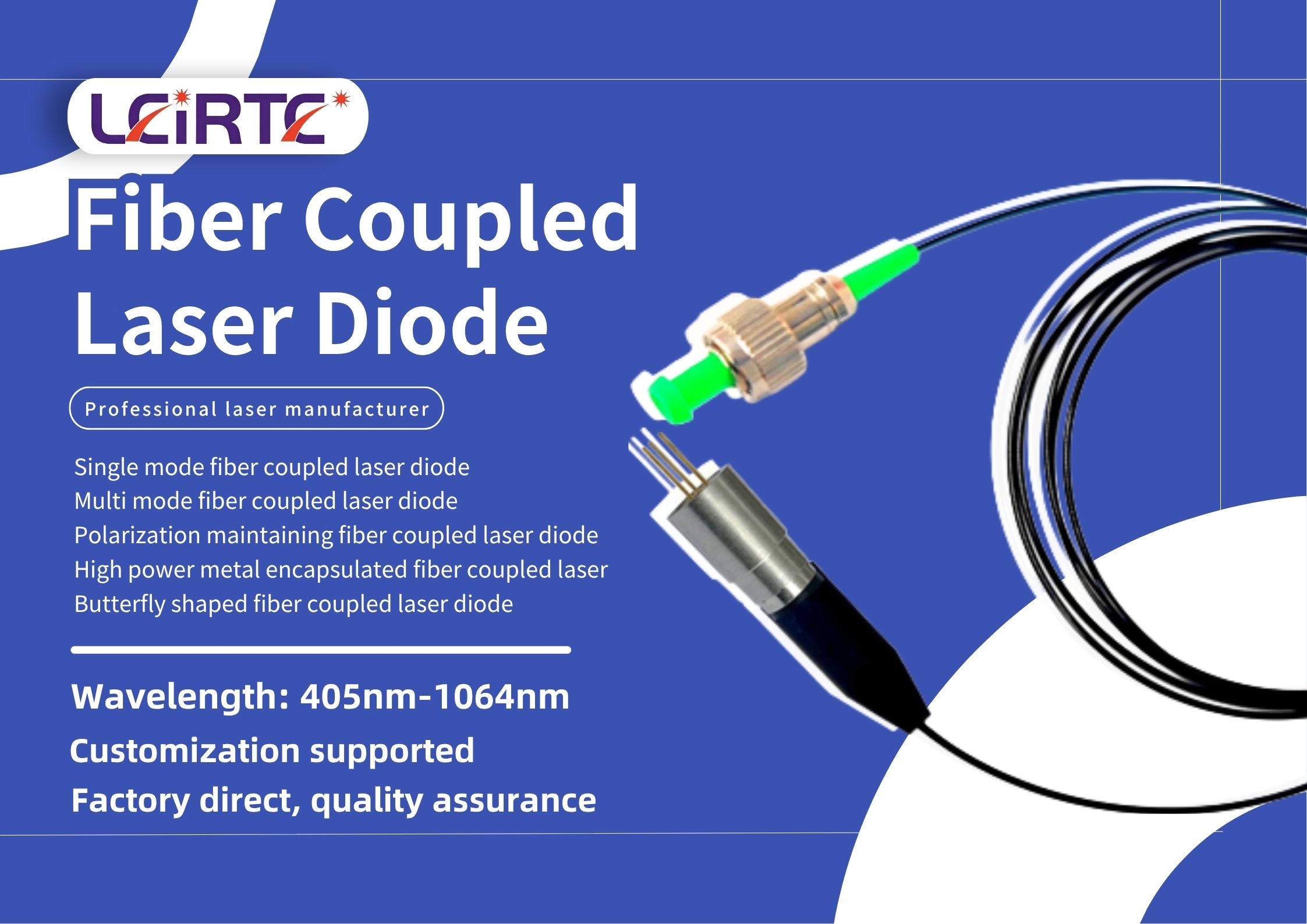
Leirte is a professional manufacturer of
fiber coupled lasers
, with a complete range of models and support for customization.
FAQ
Q: What is cladding pumping for fiber lasers?Cladding pumping injects pump light into the inner cladding of double-clad fiber. Pump light bounces inside the inner cladding and crosses the rare-earth doped core repeatedly to generate laser amplification.
Q: What is a pump combiner?A pump combiner is a fused all-fiber component that merges multiple fiber-coupled pump diode outputs into one single fiber feeding the gain fiber. It is the core component for all-fiber power scaling.
Q: Can free-space coupling reach kilowatt fiber laser power?It is technically possible, but thermal drift, alignment instability and contamination risk make free-space coupling unsuitable for long-running industrial kilowatt-class lasers.
Q: Why choose fiber-coupled pump diodes over bare laser diodes?Fiber-coupled pump diodes integrate beam shaping optics inside sealed packaging. Their fixed fiber output eliminates on-site free-space alignment work and improves consistency.
Q: What is the typical coupling loss of a good pump combiner?Well-manufactured pump combiners can keep pump insertion loss well below 1~2%, depending on wavelength, fiber core size and fusion technology.
English
Name*
phone number/ Whatsapp / Wechat*
Email
message*