
How to Select Erbium Glass Laser Ranging Module
Choose the right erbium glass laser ranging product
Learn how to select erbium glass laser ranging modules, key parameters including wavelength, range, accuracy, beam divergence, operating temperature and integration interface. Compare with 905nm laser modules and check eye-safety & industrial application requirements.
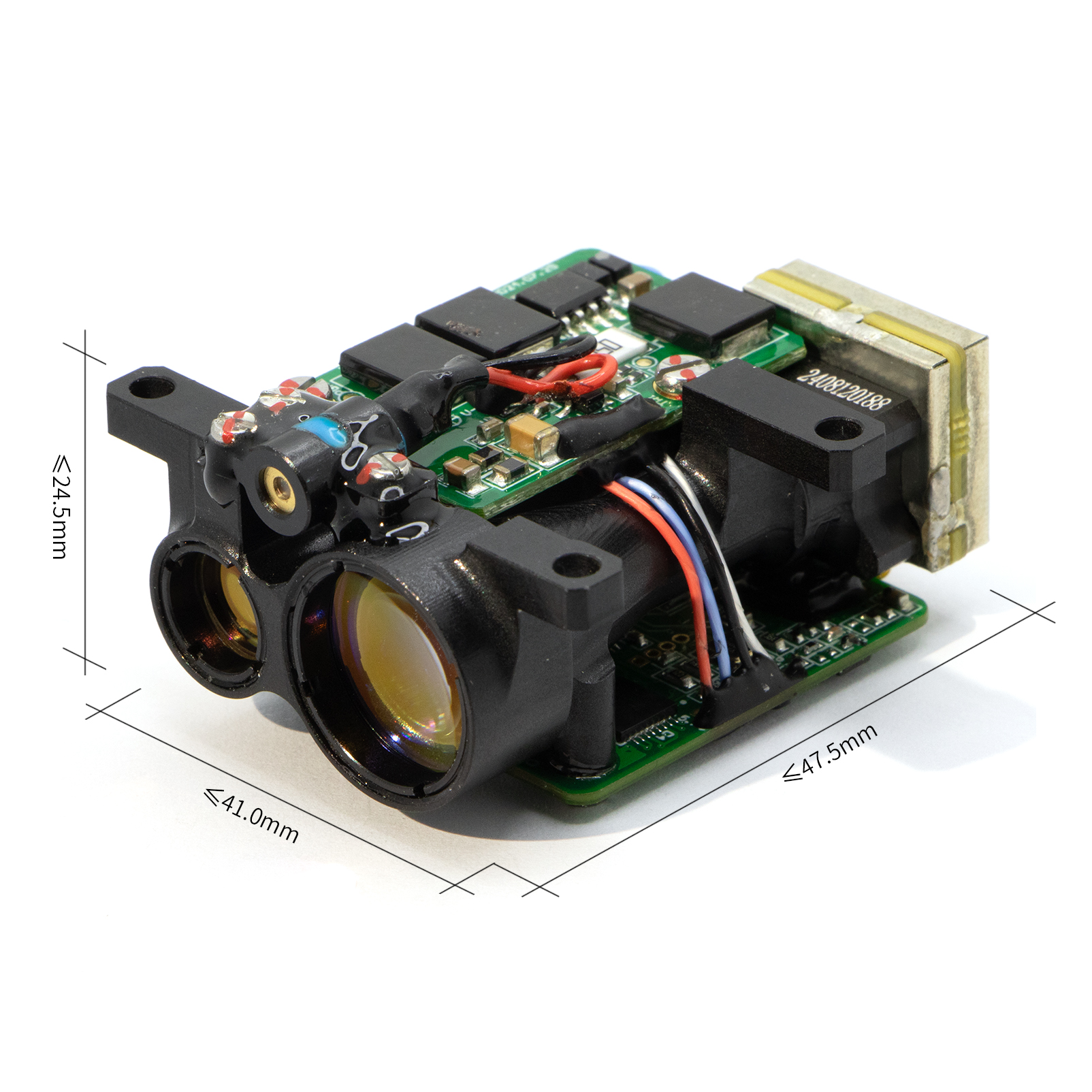
Introduction
Erbium glass laser ranging modules adopt 1535nm eye-safe pulsed laser source, widely used for long-distance ToF ranging. Unlike conventional 905nm laser diodes, erbium glass laser stays within Class 1 eye-safe standard, with superior penetration in fog, dust and poor weather conditions. It is a top choice for UAV payloads, long-distance surveying, perimeter monitoring and industrial long-range detection.
Many system integrators and OEM buyers struggle with module selection. Improper specification matching will lead to failed ranging, unstable return signal or oversize/overweight issues for your end equipment. This article lists core criteria and common pitfalls to help you pick the suitable erbium glass laser ranging module quickly.
1. Confirm Core Optical & Ranging Parameters
Measuring Range & Ranging Probability
First define your effective working range. Erbium glass modules can cover from several hundred meters up to 15km+. Pay attention to the ranging probability instead of only maximum range. Max range is usually tested under ideal reflectivity target; ranging probability indicates success rate under real-world environment, especially for low-reflectivity targets such as dark rock, vegetation.
Ranging Accuracy & Update Rate
Accuracy: Typically ±0.5m ~ ±1m for long-range models. For high-precision survey, select tighter tolerance.
Update rate: 1Hz ~ 10Hz is common. Higher refresh rate suits moving platform like UAV, while low repetition rate reduces power consumption for stationary monitoring.
Beam Divergence
Beam divergence decides laser spot size at far distance. Narrow divergence (0.3~0.6mrad) concentrates laser energy for long-distance measurement; wider divergence fits close-range scanning. Too large divergence causes energy dispersion and reduces maximum detectable range.
Pulse Energy & Pulse Width
Higher pulse energy enhances return signal for bad weather. Narrow pulse width (nanosecond level) helps improve ranging precision. Balance energy with eye-safety limits.
2. Eye Safety & Wavelength
Erbium glass laser works at 1535nm wavelength. This infrared light is absorbed by cornea, cannot reach retina, achieving Class 1 eye safety. Compare with 905nm laser diode: 905nm may cause retinal injury at high power and requires stricter protective measures. If operators or people may appear within laser path, erbium glass module is strongly recommended.
3. Environmental Adaptability
Check operating temperature range. Industrial-grade erbium glass modules commonly support -40℃ ~ +65℃. For outdoor, airborne or field applications, confirm vibration resistance, shock resistance and IP sealing rating. Ambient condition matters: fog, rain, dust, strong sunlight will weaken echo signal. Erbium glass has better atmospheric transmission than 905nm, but you still need to match pulse energy for your worst working condition.
4. Mechanical, Power & Electrical Interface
Dimension & weight: Critical for UAV, handheld rangefinder. Miniature sealed packages reduce payload burden.
Power supply: Voltage, peak current and average power consumption. Battery-powered portable devices need low average power.
Communication interface: RS485, TTL, UART, Modbus. Confirm protocol compatibility with your host controller or PLC.
Trigger mode: Internal auto-trigger or external trigger for synchronous system integration.
5. Manufacturing & Customization Capacity
For OEM projects, verify whether the supplier can customize optical lens, housing, connector, firmware and beam expander. Ask for sample test, long-term stability report, temperature cycling test data. Factory with mass production capacity ensures consistent performance and fast delivery.
6. Compare Erbium Glass Module vs 905nm Laser Ranging Module
| Item | Erbium Glass (1535nm) | 905nm Laser Diode |
|---|---|---|
| Eye Safety | Class1 eye-safe | Higher risk to retina |
| Weather Penetration | Better in fog & haze | Ordinary |
| Max Range | Long range, up to 15km+ | Usually within 2~3km |
| Size & Cost | Larger, higher cost | Compact, low cost |
| Typical Use | UAV, long-range monitoring, survey | Short/medium industrial automation |
Common Application Scenarios
UAV payload: aerial survey, terrain measurement, obstacle avoidance
Perimeter security: long-distance intrusion detection
Handheld rangefinder: field mapping, engineering survey
Industrial monitoring: silo level, large structure deformation monitoring
FAQ
Q1: Is 1535nm erbium glass laser completely safe for human eyes?
A: Yes, within Class 1 safety rating. 1535nm infrared light is absorbed by eye cornea and will not damage retina under normal operation.
Q2: Can I replace a 905nm module directly with erbium glass module?
A: Not plug-and-play. Different power consumption, optical aperture and signal circuit. You need to re-design power and optical structure.
Q3: What is the main limitation of erbium glass laser ranging module?
A: Higher cost and larger package compared to 905nm diode modules. It also has thermal accumulation under high repetition frequency.
Conclusion
When selecting erbium glass laser ranging module, prioritize working range, ranging probability, beam divergence, temperature grade and interface compatibility. If your project requires long-distance measurement, outdoor harsh environment and eye safety, erbium glass 1535nm module is your ideal option. Our factory supplies standard and customized erbium glass laser ranging modules, we provide sample testing, technical support and fast delivery for your OEM & system integration projects.
For long-distance outdoor measurement, the 1535nm laser ranging module delivers excellent eye safety and stable ranging performance in foggy environments.
English
Name*
phone number/ Whatsapp / Wechat*
Email
message*