
Why Can Laser Light Travel Through Optical Fiber?
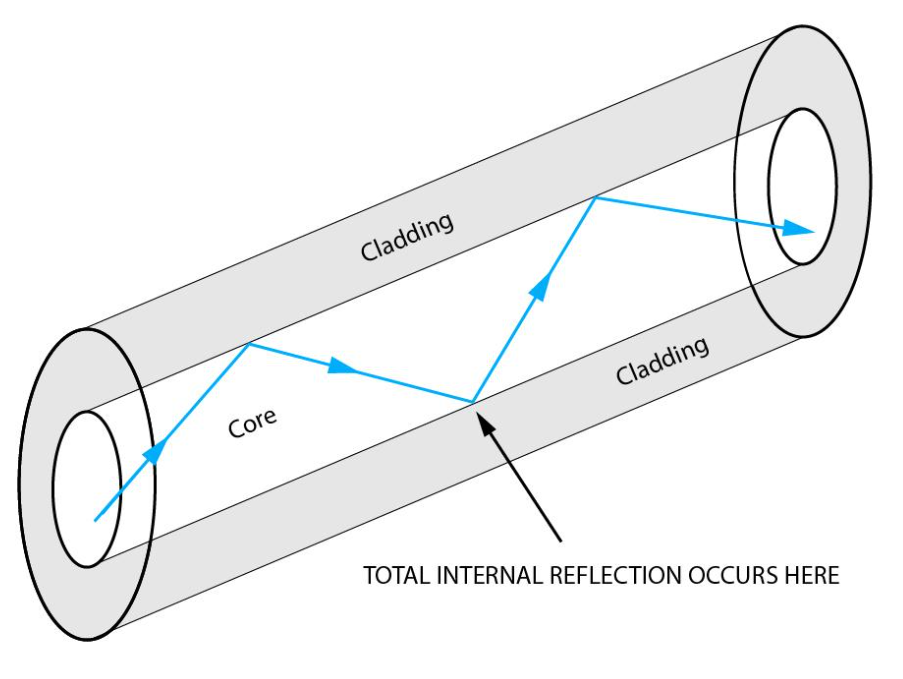
Laser light can travel through an optical fiber mainly because of a phenomenon called Total Internal Reflection (TIR).
An optical fiber consists of three main parts: the core, the cladding, and the protective coating. The core has a higher refractive index than the cladding, allowing light to remain confined within the core under the appropriate optical conditions.
When laser light enters the fiber at a suitable angle, it reaches the boundary between the core and the cladding. Instead of passing through the cladding, the light undergoes total internal reflection and is reflected back into the core.
As this process repeats along the fiber, the laser light travels from one end to the other with relatively low optical loss.
This is why optical fibers can transmit laser light over long distances while maintaining efficient light transmission.
In simple terms: An optical fiber acts like a tiny light-guiding channel, keeping laser light inside through repeated total internal reflection.
English
Name*
phone number/ Whatsapp / Wechat*
Email
message*