
What Is Single-Mode Polarization-Maintaining Fiber?
Single-Mode Polarization-Maintaining Fiber (PM Fiber) is a special type of optical fiber that transmits light in a single mode while maintaining a relatively stable polarization state during transmission.
Ordinary single-mode fiber mainly ensures single-mode light transmission, while single-mode PM fiber not only transmits single-mode light but also helps preserve the polarization state of the incoming light.
1. Working Principle
In ordinary single-mode fiber, factors such as internal stress and bending may cause changes in the polarization direction of light.
PM fiber uses a specially designed structure to create a significant difference in propagation constants between two perpendicular polarization axes (birefringence). This allows the polarization state of light to remain stable along a designated axis during transmission.
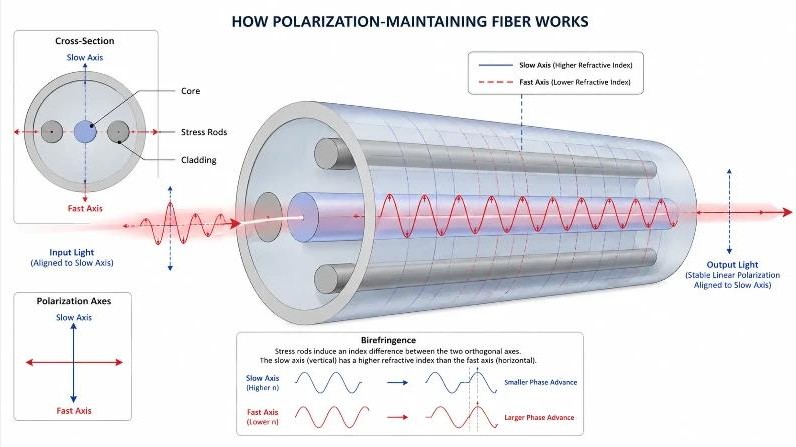
Common PM fiber structures include:
- PANDA Type: Uses two stress-applying regions to create birefringence. It is one of the most common PM fiber designs.
- Bow-Tie Type: Uses specially designed stress regions to maintain the polarization state of light.
- Elliptical-Core Type: Uses a non-circular core structure to generate birefringence.
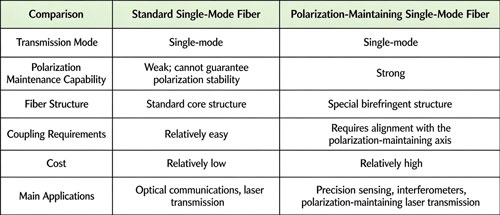
2. Differences Between Single-Mode Fiber and Single-Mode PM Fiber
3. Main Applications
Fiber Optic Gyroscopes: Used for high-precision angular velocity measurement.
Fiber Optic Interferometers: Maintain polarization stability and improve measurement accuracy.
Fiber-Coupled Lasers: Used in laser systems requiring stable polarization output.
Fiber Optic Sensors: Used in high-precision optical measurement and sensing applications.
4. How to Choose Between Ordinary Single-Mode Fiber and PM Fiber?
If the main requirement is stable optical signal transmission and polarization direction is not particularly important, ordinary single-mode fiber is sufficient.
If the laser output requires a stable linear polarization direction, or if the system is highly sensitive to polarization changes, single-mode PM fiber is recommended.
Important Note
PM fiber does not automatically convert arbitrary incoming light into linearly polarized light. The input light must have a suitable linear polarization state and be accurately aligned with the fiber's fast or slow axis to achieve effective polarization maintenance.
English
Name*
phone number/ Whatsapp / Wechat*
Email
message*