
What is the operating principle of a photodiode?
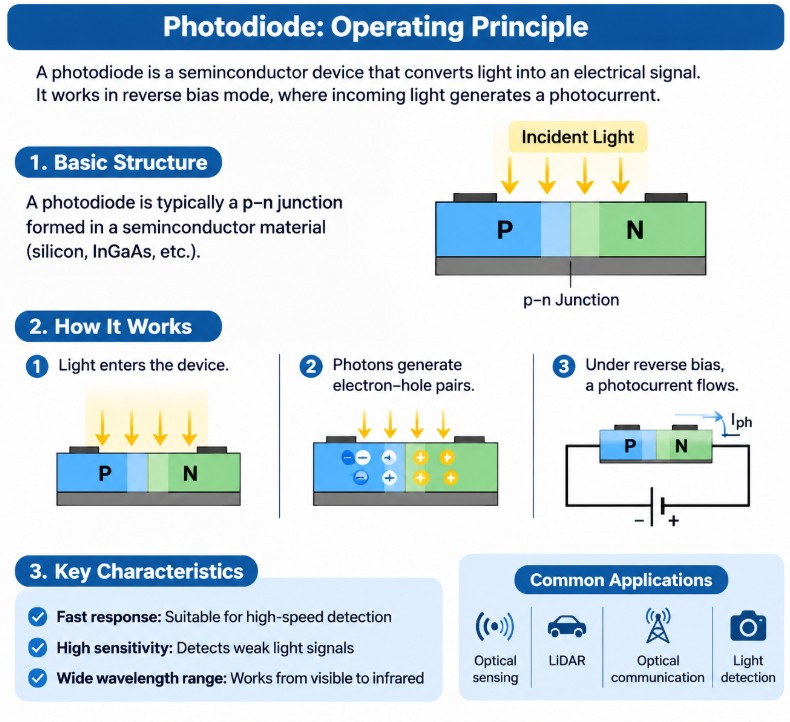
A photodiode is a semiconductor optoelectronic device that converts light energy into electrical current. It is widely used in optical communication, laser detection, LiDAR, light sensors, and industrial measurement systems.
Its basic operating principle is the photoelectric effect in a semiconductor PN junction: when light enters the photodiode's photosensitive region, photons generate electron-hole pairs, producing an electrical current.
1. How does a photodiode work?
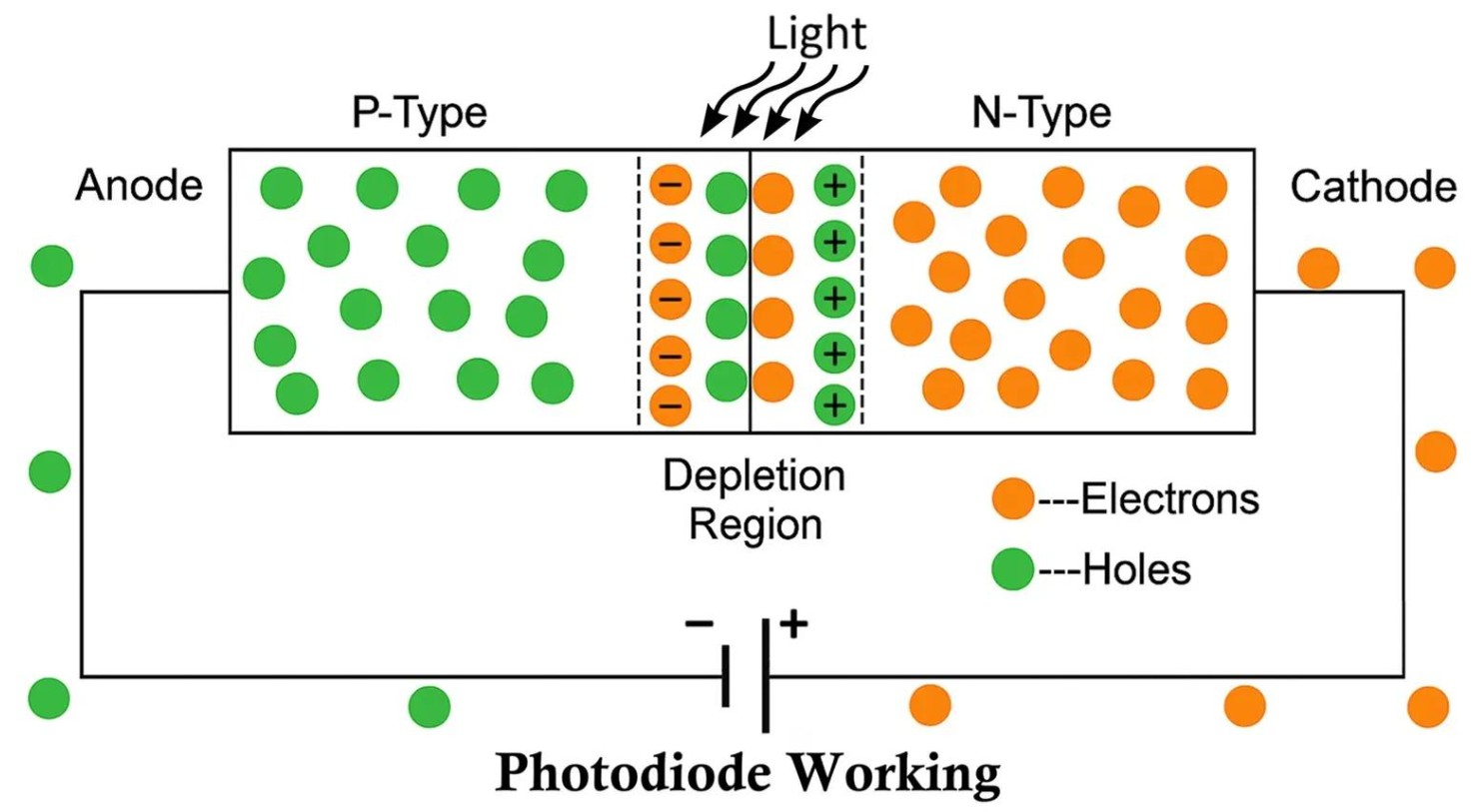
The operating process consists of four basic steps:
1. Light absorption: When photons enter the photodiode, they are absorbed by the semiconductor material.
2. Electron-hole generation: The absorbed light energy generates electron-hole pairs.
3. Charge separation: The electric field in the depletion region separates electrons and holes, driving them toward opposite sides of the junction.
4. Current generation: The movement of these charges produces a photocurrent in the external circuit.
Generally, stronger incident light produces a larger photocurrent, provided the detector is operating within its linear range.
2. Why is a photodiode usually operated in reverse bias?
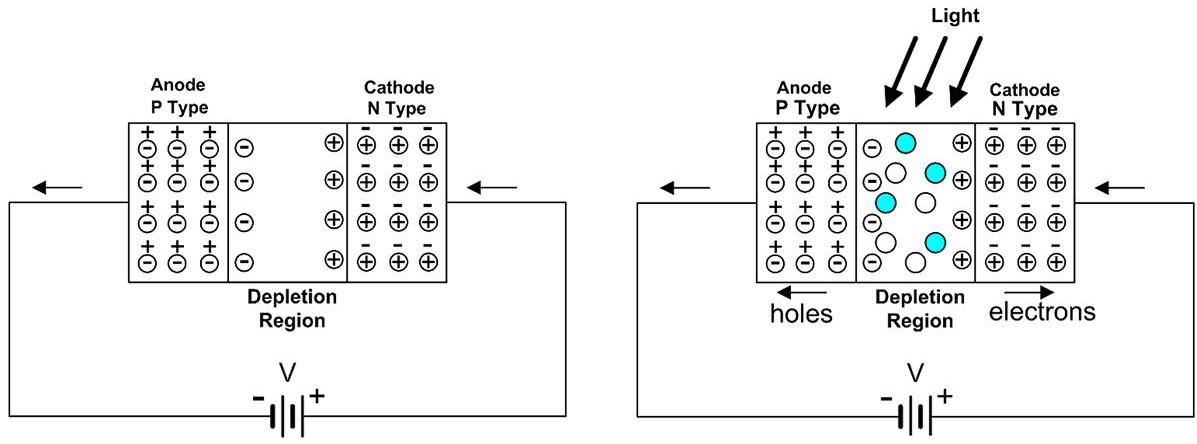
Photodiodes commonly operate in two modes:
Reverse bias widens the depletion region and strengthens the electric field, helping separate photogenerated charges quickly.
3. Important photodiode characteristics
Responsivity: Measures how much photocurrent is generated per unit of incident optical power (A/W).
Response time: Determines how quickly the photodiode responds to changing light signals.
Dark current: Small current that flows even without incident light.
Spectral response: Indicates which wavelengths the photodiode can detect.
Sensitivity: Determines its ability to detect weak optical signals.
4. Summary
The photodiode converts incoming light into electrical current through the generation and separation of electron-hole pairs in a semiconductor junction.
Its key advantages are high sensitivity, fast response, compact size, and reliable optical detection.
A simple way to understand it:
Light in → Electron-hole pairs generated → Photocurrent produced → Electrical signal output.
This is why photodiodes are essential receiver components in laser systems, optical communication equipment, and LiDAR applications.
English
Name*
phone number/ Whatsapp / Wechat*
Email
message*